


Product data sheet:
Flat Jet Blowing Nozzle Series BJP - 1/4G
| Range | Blowing |
|---|---|
| Category | Blower nozzles |
| Kind | Flat Jet |
| Series | BJP |
| Height (in mm) | 17.5 |
| Length | 52 mm |
| Air supply | Female G1/4" |
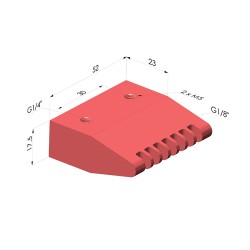
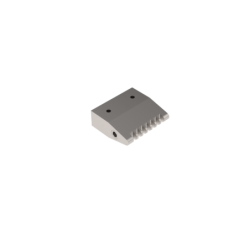
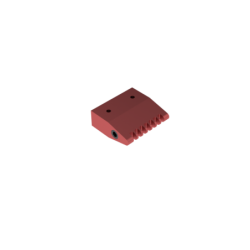
Variant reference: BJP 14 52 ACI
- Matter: 316L Stainless Steel
Variant reference: BJP 14 52
- Matter: Aluminum
TECHNICAL INFORMATION
| BENEFITS OF USING THE BLOWING NOZZLE BJP 14 52* (compared with an open pipe) |
Increase in blowing flow (%) |
Noise reduction (%) | ||||||
|---|---|---|---|---|---|---|---|---|
| up to +111% |
up to -33% |
|||||||
| PERFORMANCE OF THE BLOWING NOZZLE BJP 14 52* |
Pressure (bar) | Air consumption (l/min) | Thrust force (N) | Noise level (dB) | Blowing flow (l/min) | |||
| 6 | 800 | |||||||
| at 150mm | at 450mm | 72 | 5370 | |||||
| 9 | 7 | |||||||
| VS | ||||||||
| OPEN PIPE Ø8 INTERNAL* |
Pressure (bar) | Air consumption (l/min) | Noise level (dB) | Blowing flow (l/min) | ||||
| 6 | 2550 | 108 | 2550 | |||||
BJP 14 52 BLOWING NOZZLE SPECIFICATIONS
• Connection: Female G1/4" • Weight: Aluminium: 56g / 316L stainless steel: 225g
• Maximum operating temperature: Aluminium: 150°C / 316L stainless steel: 450°C • Maximum pressure: 10 bar
* NOTE: The measurements presented in this technical data sheet were carried out in a laboratory under strictly controlled conditions.
It is important to note that conditions in an actual industrial environment may differ and that pressure instability from an industrial compressor may result in values different from those obtained in the laboratory. This data is provided for information purposes only.
For optimum blowing nozzle performance, we recommend a compressed air supply hose with a minimum internal diameter of 8 mm.
DESCRIPTION
NOVACOM develops and designs flat jet blowing nozzles in France. They are ideal for boosted blowing operations, as well as for cleaning and cooling applications.
NOVACOM flat jet nozzles can incorporate a controllable solenoid valve. Thanks to their compact design, these nozzles optimize the working space while improving the ergonomics and productivity of operations. They consume compressed air only when required, providing significant savings while also considerably reducing overall noise levels in working environments.
OPERATING PRINCIPLE

The incoming compressed air produces a constant and uniform airflow, expelled at high speed through the outlet openings.
Thanks to the Coanda effect, a phenomenon in fluid mechanics, ambient air is drawn in around the fins, thereby increasing the initial airflow.