


Product data sheet:
Circular Air Knives Series RAC-2 - ØInt 51MM
| Range | Blowing |
|---|---|
| Category | Air curtains |
| Kind | Circular |
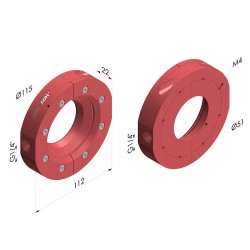
| Power Connection | G1/4" |
| Series | RAC-2 |
| Width | 22 mm |
| Outer diameter | 112 mm |
| Inner diameter | 51 mm |
| Thread | M4 |
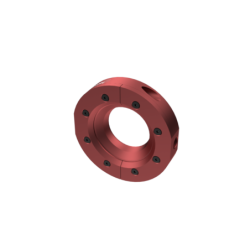
Variant reference: RAC-2 51
- Matter: Aluminum
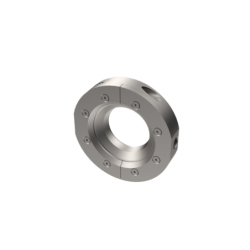
Variant reference: RAC-2 51 ACI
- Matter: 316L Stainless Steel
TECHNICAL INFORMATION
| BENEFITS OF USING THE AIR CURTAIN RAC-2 51* (compared with an open pipe) |
Reduction in air consumption (%) |
Noise reduction (%) | ||||||
|---|---|---|---|---|---|---|---|---|
| up to -92% |
up to -38% |
|||||||
| PERFORMANCE OF THE AIR CURTAIN RAC-2 51* |
Pressure (bar) | Air consumption (l/min) | Thrust force (N) | Noise level (dB) | Blowing flow (l/min) | |||
| at 150mm | at 450mm | |||||||
| 2 | 510 | 4.6 | 4.2 | 81 | 12750 | |||
| 6 | 1450 | 12.5 | 11.5 | 90 | 36250 | |||
| VS | ||||||||
| OPEN PIPE Ø8 INTERNAL* (cut to 110 mm) |
Pressure (bar) | Air consumption (l/min) | Noise level (dB) | Blowing flow (l/min) | ||||
| 6 | 6200 | 130 | 6200 | |||||
RAC-2 51 AIR CURTAIN SPECIFICATIONS*
• Connection: Female G1/4" • Weight: Aluminium: ---g / 316L stainless steel: ---g
• Maximum operating temperature: Aluminium: 150 °C / 316L stainless steel: 450 °C • Maximum pressure: 10 bar
* NOTE: The measurements presented in this technical data sheet were carried out in a laboratory under strictly controlled conditions.
It is important to note that conditions in an actual industrial environment may differ and that pressure instability from an industrial compressor may result in values different from those obtained in the laboratory.
This data is provided for information purposes only.
For optimum circular air curtain performance, we recommend a compressed air supply hose with a minimum internal diameter of 8 mm.
DESCRIPTION
NOVACOM develops and designs circular airflow air curtains in France.
They are used for energy-efficient blowing, cleaning and cooling operations on profiled components.
OPERATING PRINCIPLE

The incoming compressed air generates a high-speed, continuous and uniform circular airflow that travels along the internal surface.
Thanks to the Coanda effect, a phenomenon in fluid mechanics, ambient air is drawn in and added to the initial airflow.